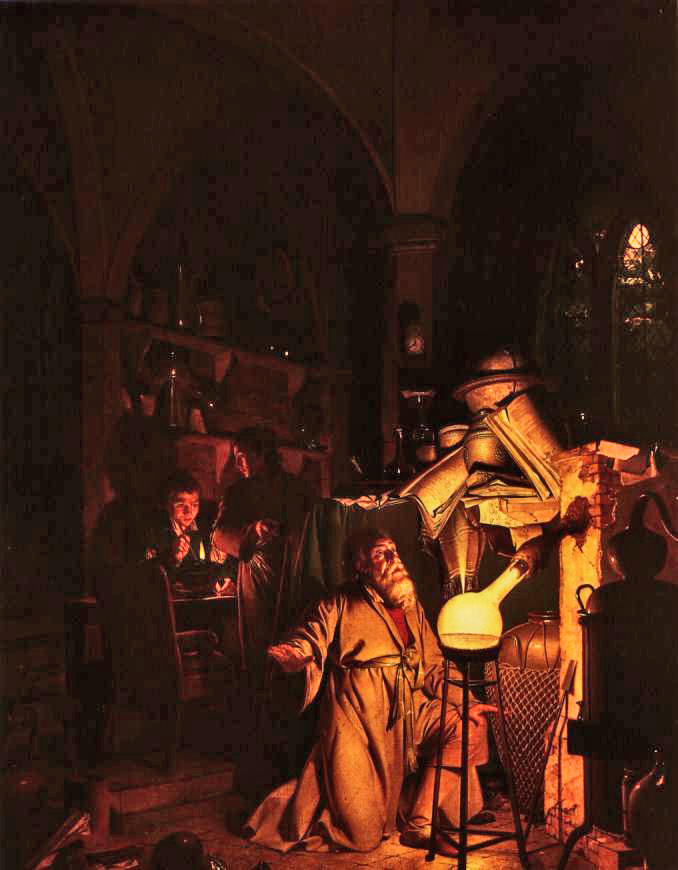
After
reading the Canon’s Yeoman’s Tale, the importance of alchemy has been on my
mind. In doing additional research, there are many angles concerning Alchemy
which I hadn’t considered. Alchemy is a
proto-chemistry, which involved mixing elements to create new things. The ultimate
goal, as we’ve discussed, was to create a philosopher’s stone, something which
has been said to turn any base metal into gold, (in some cases) to heal any
disease and/or to offer immortality to anyone who ingested a potion which
incorporated it.
Now,
while we scoff a bit in our modern age, especially at the story of the Canon’s
Yeoman’s where an alchemist specifically chooses to dupe the priest into
believing he is actually performing alchemy, there are elements to alchemy as a
science which I had not considered. Namely, we discussed the possibility that
alchemy could be considered evil because it creates something from nothing, but
this is not actually the case. Like a recipe, alchemy utilizes many different ingredients
to make a final product. To use a borrowed phrase about alchemy, it’s the law
of equivalent exchange—where you put in the things which make up the final
thing you hope to create. While the end
result of the philosopher’s stone would be making gold in an almost magical
way, it’s not creating something from nothing.
In
reading an article from Peggy Knapp entitled “The Work of Alchemy,” she raised
an interesting point to me about why clergy would’ve allowed alchemy and not
magic. According to Knapp, “Alchemical treatises share a few basic
ideas: that alchemy speeds up processes already at work in Nature, that gold
represents the perfect balance between the elements of earth, water, air and
fire toward which Nature is heading, and that alchemy could hurry the lower
metals toward gold through “projections” involving mercury, sulfur and furnaces”
(Knapp, 575). This means that alchemy
itself wasn’t reaching beyond the bounds of humanity, instead it was simply
hurrying along a process which God already set in motion. Therefore, the
philosopher’s stone was something which not only encouraged the natural order
of things, but also embodied and kept the secrets of creation, and therefore,
of God as well.
Part of the rules of alchemy, as mentioned, were of equivalent
exchange. In most alchemic texts there were directions to create a chemical
wedding, where all the elements needed to create the philosopher’s stone were
actually to be “married” or unified together. The most important point though
for this chemical union was actually for there to be balance—between the
elements of gold and silver, of the sun and the moon, of fire and water. In creating anything alchemical, there must
be balance for the union to occur—too much or too little of anything would
cause disastrous results. There is also
a balance needed between the knowledge behind the science of alchemy and the
physical work and timing which goes into each alchemical reaction. A perfectly balanced person is the start of a
perfectly balanced equation for alchemy.
This then made me reconsider the problems with the Canon’s
Yeoman’s tale. The deceit of the
alchemist towards the priest is not just buffoonery to be ridiculous or to show
that you shouldn’t put your faith in things which are unholy, but to show that charlatans
exist partly because part of themselves is unbalanced, much like this alchemist’s
“alchemy.” Without balance, one could
not achieve happiness, for one would not be able to find a balance between work
and home, or earth and heaven. The
proper balance of common sense and intelligence is needed for a professions such
as an alchemist’s, but also for a priest, who should’ve been somewhat educated,
to know that this alchemist was not what he seemed. This imbalance of knowledge is even more
apparent in the alchemist, because he cannot be someone who had actually
studied alchemic texts, because he relies entirely on parlor tricks to get his
victims to believe that he is truly noteworthy and someone who understands the
secrets of creation. And yet, at the
same time, it occurs to me that only others who are similarly imbalanced would
trust a con artist.
While many may think that Chaucer was simply angry
towards someone who cheated him and claimed to be an alchemist, and that interpretation
makes complete sense, I feel differently.
In this case, the message might be for us to be wary of things which
seem too good to be true, but additionally to find a true unity with our
creator in order for the true transformation to begin. In this way, perhaps we can work towards
finding a balance in our own lives to begin the journey of recreation!