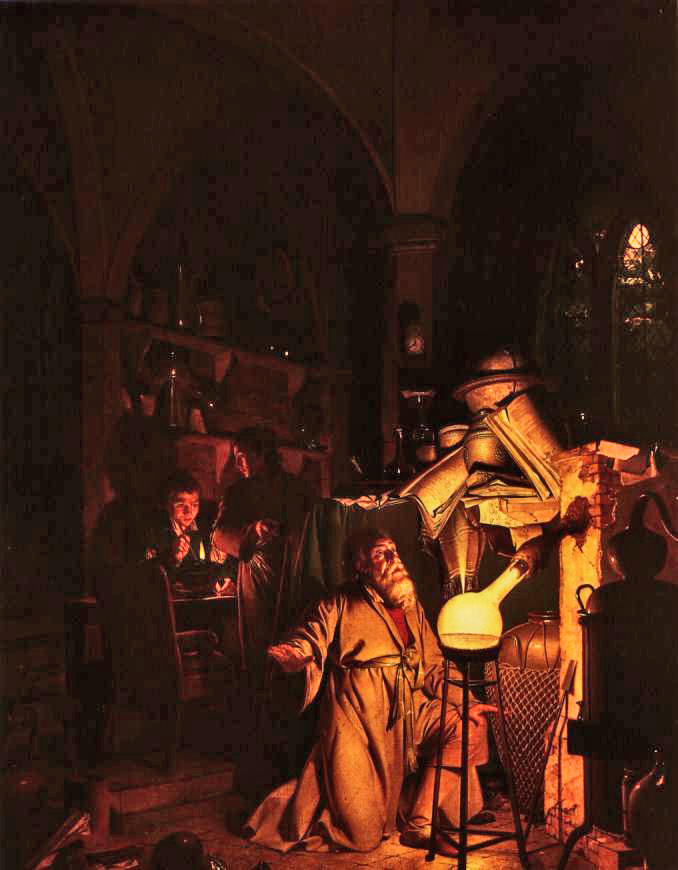
The canon’s yeoman is not
the first scientist/magician we have met throughout the Canterbury Tales and yet the treatment of alchemy seems unique
among collection of physicians, magicians, and illusionists. Probably one of
the best (and most concise) descriptions of the foolery that is alchemy comes
in the “Canon’s Yeoman’s Tale,” starting around line 906 and ending at 931. This
is the moment the yeomen describes the catastrophe that occurred when their
clay pot broke. He describes the explosion of the contents as such:
They percen so, and thurgh the wal they goon,
and somme of hem sinken into the ground—
Thus han we lost betimes many a pound—
And somme ar scattered al the floor aboute,
Somme lepe into the roof. Withouten doute, (911-915)
To add to the chaos of molten who-knows-what scattered
about the room we then get alchemists scattered about the room blaming each
other for the mishap. From their conversation it seems like they actually have
no idea what happened. It was a fault of the fire, no the fire tender; actually
it was the wrong kind of wood. Finally the master alchemist chimes in, “I am
right skier that the pot was crased. / Be as be may, be ye nothing amased”
(934-935), in other words, “cheer up. If the pot broke it was obviously already
damaged; let’s try again our mix of explosive, molten stuff!” The overwhelming,
overarching point of the Yeoman and his tale aside, this scene is beyond ridiculous
even without knowing how ridiculous alchemy is from a scientific standpoint.
Considering this outlook on alchemy, which is almost inseparable from other
aspects of medieval science, I thought it interesting that the other appearances
of similar things in the CT are put in a sober light. The wife of the knight in
the WOB’s tale has both a sharp reason and the ability to shape shift. The physician
gets probably the saddest and most sobering tale in the whole collection. Every
wondrous gift in “The Squire’s Tale” seems cool beyond belief but also based on
(what were then) reasonable ideas. And while the illusionist in “The Franklin’s
Tale” may charge a lot of money, he delivers on his promised spells and they
work fantastically.
In
trying to understand this difference, I looked back at the illusionist in “The Franklin’s
Tale.” His process for creating his spells is completely different from the alchemists’.
Where all of their emphasis is on the varying combinations of ingredients they
add, the illusionist spends all of his time waiting, “That night and day he
spedde him that he kan / To waite a time of his conclusioun” (“The Franklin’s
Tale” 1262-1263). Further, he finally creates his spell when “at laste he hath
his time yfounde” (1270). It seems then is that for the illusionist timing is
literally everything. He knows enough about how the heavens move and how that
affects the earth that he need only attempt is spell in its proper place for it
to work. It might be a stretch, but this seems to tie into the theme of knowing
your place and doing it well that is exemplified by several other tales in this
text. Perhaps the reason that alchemy is not treated seriously is because
almost by its nature it is trying to disrupt the order of things instead of
using them, making gold of lead. That may not be a 100% true all the time but
it seems to be part of what Chaucer is doing with alchemy.