Thursday, December 5, 2013

LOL Manciple

For more LOL Pilgrims: http://houseoffame.blogspot.com/2007/05/i-can-hath-cheezburger.html

There's something simple and appealing about The Manciple's Tale. It remains one of my favorites because it sounds like the kind of story you would hear as a child, something out of Aesop's Fables.

The funny thing about it, though, is that the Manciple's mother isn't very good at taking her own advice. How long is that speech telling him to guard his tongue and not use more words than are strictly required? ;-)

Leave Order Out of the Pot


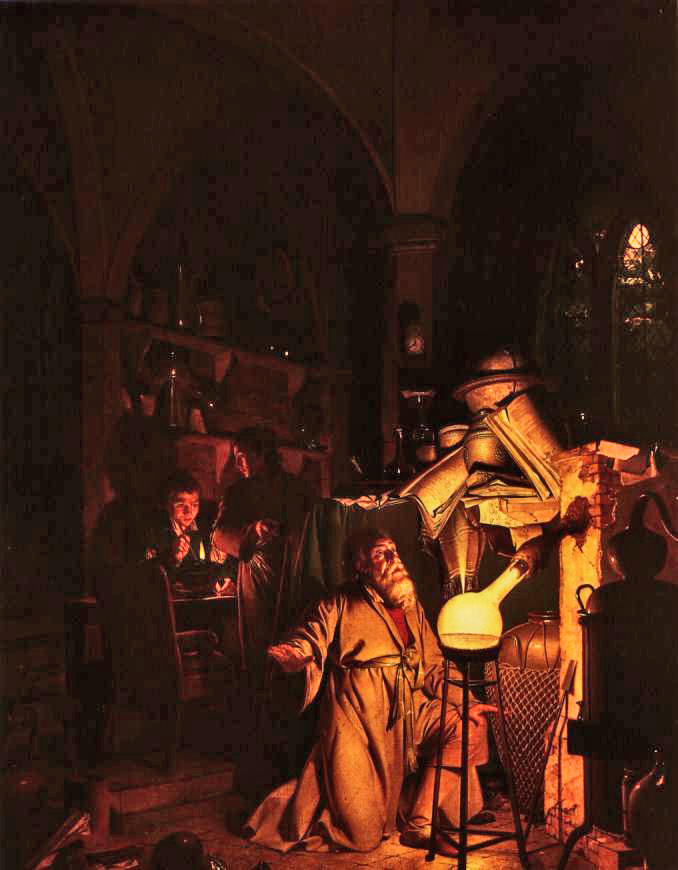
The canon’s yeoman is not the first scientist/magician we have met throughout the Canterbury Tales and yet the treatment of alchemy seems unique among collection of physicians, magicians, and illusionists. Probably one of the best (and most concise) descriptions of the foolery that is alchemy comes in the “Canon’s Yeoman’s Tale,” starting around line 906 and ending at 931. This is the moment the yeomen describes the catastrophe that occurred when their clay pot broke. He describes the explosion of the contents as such:
   Alchemist Pic Link
They percen so, and thurgh the wal they goon,
and somme of hem sinken into the ground—
Thus han we lost betimes many a pound—
And somme ar scattered al the floor aboute,
Somme lepe into the roof. Withouten doute, (911-915)

To add to the chaos of molten who-knows-what scattered about the room we then get alchemists scattered about the room blaming each other for the mishap. From their conversation it seems like they actually have no idea what happened. It was a fault of the fire, no the fire tender; actually it was the wrong kind of wood. Finally the master alchemist chimes in, “I am right skier that the pot was crased. / Be as be may, be ye nothing amased” (934-935), in other words, “cheer up. If the pot broke it was obviously already damaged; let’s try again our mix of explosive, molten stuff!” The overwhelming, overarching point of the Yeoman and his tale aside, this scene is beyond ridiculous even without knowing how ridiculous alchemy is from a scientific standpoint. Considering this outlook on alchemy, which is almost inseparable from other aspects of medieval science, I thought it interesting that the other appearances of similar things in the CT are put in a sober light. The wife of the knight in the WOB’s tale has both a sharp reason and the ability to shape shift. The physician gets probably the saddest and most sobering tale in the whole collection. Every wondrous gift in “The Squire’s Tale” seems cool beyond belief but also based on (what were then) reasonable ideas. And while the illusionist in “The Franklin’s Tale” may charge a lot of money, he delivers on his promised spells and they work fantastically.

            In trying to understand this difference, I looked back at the illusionist in “The Franklin’s Tale.” His process for creating his spells is completely different from the alchemists’. Where all of their emphasis is on the varying combinations of ingredients they add, the illusionist spends all of his time waiting, “That night and day he spedde him that he kan / To waite a time of his conclusioun” (“The Franklin’s Tale” 1262-1263). Further, he finally creates his spell when “at laste he hath his time yfounde” (1270). It seems then is that for the illusionist timing is literally everything. He knows enough about how the heavens move and how that affects the earth that he need only attempt is spell in its proper place for it to work. It might be a stretch, but this seems to tie into the theme of knowing your place and doing it well that is exemplified by several other tales in this text. Perhaps the reason that alchemy is not treated seriously is because almost by its nature it is trying to disrupt the order of things instead of using them, making gold of lead. That may not be a 100% true all the time but it seems to be part of what Chaucer is doing with alchemy.

Monday, December 2, 2013

"The Second Nun's Tale"

In the prologue to the tale, the Mother Superior's assistant tells us that she will speak about idleness and how it leads to Satan. What is interesting is that tale says a lot about the status of the woman telling the tale.

Instead of being just a recount of the story of St. Cecile, which is questionable, the Second Nun proves that she is a more intellectual than emotional being. Of course, women were not as highly educated as men in the Middle Ages, but that is not the question here. It seems to me that the intellectual tone of the tale mimics the typical plot of a female martyr story. Female martyrs were most commonly up against men and outargue them. This tale is set up as a response to "The Prioress's Tale"

First, at line 123, the Second Nun describes St. Cecile as, "Of Crist, and bar his gospel in hir mynde. / She vevere cessed, as I writen fynde, / Of hir preyree and God to love and drede" (SNT 123-25). St. Cecile has memorized the gospels and has no need of an intercessor between her and God. For Catholics, the middle-man of the priest is essential to communication with God. Thus, St. Cecile renders her male counterparts useless in her religious pursuits.

Again, at lines 337-343, St. Cecile is associated with the intellectual.

"That shal I tell," quod she, "er Igo.
Right as a man hath sapiences three--
Memorie, engyn, and intellect also--
So in o beynge of divinitee,
Thre persons may ther right wel bee."
Tho gan she hym ful busily to preche
Of Cristes come, and of his peynes teche, (SNT 337-43)

Two things are apparent here. First, she is associated totally with the intellect. In fact, there is no language that suggests there is some kind of emotional connection on her part. So, is it possible that this affects the emotional connection the reader makes to the tale. Second, she takes the Holy Trinity and aligns it totally with the intellect.

All this is in contradiction with the young man in "The Prioress's Tale" who is described as,

This litel child, his litel book lernynge,
As he sat in the scole at his prymer,
He Alma redemportis herde synge,
As children lerned hire antiphoner;
And as he dorste, he drough hym ner and ner,
And herkened ay the wordes and the noote,
Til he the firste vers koude al by rote.

Noght wiste he what this Latyn was to seye,
For he so yong and tendre was of age.
But on a day his felawe gan he preye
T'expounden hym this song in his langage, (516-26)

The child has no idea what he is saying (the lack of intellect), but he likes the sound of the tune so much he retains it to memory in order to sing it. There is the emotional connection to the song, albeit passive, that the Second Nun does not give to St. Cecile. It is the lack of the intellectual understanding that leads to the boy's death.

That being said, I have a few questions I have been unable to answer. First, how does the affect which tale the reader relates to? Second, what would be the reason for St. Cecile's lack of emotional connection with the gospel? Is there more than one moral to this tale? If so, what could they be?

Saturday, November 30, 2013

The Feast

I thought a lot about the Feast when writing the reflection paper. One of the final points I made in my paper was about the customs and behaviors that we tried to practice during the meal. I was with my mom and my husband, and it was funny to try o figure out how to eat certain foods without a fork, and still look refined while doing so. It was interesting to see how much our ideas of civility and good manners have changed out of a basic task like using a fork.

The other aspect of the feast that I felt people struggle with the most was waiting until everyone served before eating. Perhaps this was difficult since how we entertain at parties have changed as well. Today, with a large gathering, people might expect a buffet table with finger foods available when someone gets hungry. Something easy, quick, and light to eat so that socializing is still the primary purpose of a party. It was difficult for some people to wait until everyone was served because of the large number of people eating. It was a challenge to adjust to different behaviors and customs to accommodate the medieval feast.

Tuesday, November 26, 2013

Bile and Vanity

There are many themes and motifs worth exploring in The Nun's Priest's Tale, but I was struck by the introduction early on of diet and body humors. The widow/dairywoman doesn't play an important role in this story, but of the few things we are told about her, one is of her diet. Chaucer tells us that, "Attempree diete was hir physik." She eats moderately and modestly. She doesn't have a rich diet-- she eats brown bread (not the Boston variety, I'll warrant) and drinks milk. She doesn't have gout (a rich man's disease) and she doesn't drink wine, either white or red.  Sometimes she has bacon and eggs, a good English (or French) supper. This aspect of the widow strikes me as an odd thing to focus on. If I were having my biography written, I would not want the focus to be on what I eat!

After we are introduced to the widow and her "doughten" the narrator focuses in on the subjects of the tale, Chanticleer and his favorite wife, Pertylote. We are told that Chanticleer's bile is black and that he is melancholy, which is redundant. Melancholics are the lovers, the poets, and the dreamers. Chanticleer doesn't disappoint.

In 2940-2950 after Chanticleer has had a dreadful nightmare, his wife tells him that he is too full of poop and he had best take a laxative. Chanticleer tells her that Pharaoh didn't need a laxative when he told his dreams to Joseph. And the rooster's dream turned out to be just as prophetic as Pharaoh's.

The sin that entrap's Chanticleer is vanity. He falls into the fox's trap of flattery. "Pride goith bifore sorewe; and the spirit schal be enhaunted byfor fallyng." So says Solomon by way of Wycliffe.

Monday, November 25, 2013

The use of Animals in Story Telling

While doing an assignment for another class I ran across something that may help to explain why the use of animals in stories is NOT as affected of animals.
The excerpt comes from E.M. Forster's Aspects of the Novel. While at the moment I can not come across the exact quote it sums up to say that animals are not as effective as people because the reader is not able to connect with an animal. The animals make-up is only understood to a certain point.
To me this means that the use of animals in stories, including The Nun's Priest Tale, satirizes the actual characters the portray. It makes the story seem almost childish. Is this story meant to be funny. Although, in class, this was much discussion about the animal aspect of the novel I am still unsure as to why Chaucer chose to use an animal in this tale.
Again, I did not really care for the story. The most important part I took from the tale was the discussion between Chauntecleer and Pertelote. I think this discussion holds a lot of meaning. Pertelote is so adamant about the lack of importance of dreams. She says
Nothing, God woot, but vaintee in swevene is.
Swevenes engendren of replexions,
And ofte of fume and complexions,
Whan humours ben to habundant in a wight. (2922)-2925)
She finds the idea of dreaming weak and makes Chauntecleer less of a man. This is the opposite of what I thought how his dream would be perceived.
I've always taken dreams as something to take serioulsyy when it is closely connected to ones life. Even in the bible dreams are taken seriously. Ironically, Pertelote confirms her point by saying "God woot".
WHat do you guys take from this dream?

Sunday, November 24, 2013

The Nun's Priest's Tale


When I originally read this tale, I did not like the story at all. I found it really hard to get into the idea of a philosophical rooster. When I read the story the first time, I interpreted the tale like a fable, but the characteristics of the rooster and the chickens distracted me from seeing any deeper meaning to the text.

The classroom discussion we had really helped me with this story. The discussion helped me see the different layers of the story, and look into the reason that animals were used instead of using human characters. Through our groups discussion we talked a lot about the meaning of the animals. Our group began looking at the farm as a Kingdom where the Rooster, Chanticleer, was behaving like the King, and the fox was an outside intruder destroying the home of the farm animals. So, this story seemed to be a statement on the hierarchal system in Medieval times in relation to royalty and the people.

After about class discussion, I actually like the story. There are so many different elements and symbolism to this story that the story is much more complicated than I initially gave the tale credit for.

The link that is attached is a children's story about the Rooster and the Fox.

Chanticleer and the Fox
By Geoffrey Chaucer
Adapted and Illustrated by Barbara Cooney
Thomas Y. Crowell Co., 1958

http://theartofchildrenspicturebooks.blogspot.com/2012/04/chanticleer-and-fox-barbara-cooney.html