Woops--my answer was too long for the comment section. Go figure....
What
good questions. I really appreciated your pointing out the images
having to do with change and transformation. I hadn't noticed that.
Here's some thoughts.
First--It's hard to say what
Chaucer, who had a different understanding of Roman mythology than we
do, and was not worried about keeping strictly to the myths, meant with
his gods.
I'm going to assume he knew the basic myths and if he was messing with them it was for a purpose.
2055--painted
on the walls pictures of hunting and shamfast chastity. Shamfast could
mean modest and humble, but also unwilling or ashamed of (MED). So we
have chicks who are modestly chaste, would be better if they weren't
chaste, or might wish to not be chaste.
According to the notes on this tale:
Calistopee (2056-2061)
--Jupiter
got her pregnant, Diana kicked her out of her group of virgins, Juno
got jealous of Jupiter and turned Calistopee into a bear, Jupiter made
her and her son into constellations. Chaucer changes the myth so that
Diana was the one that got mad and got even. So the problem goes from
philandering husband and jealous wife, to leaving the goddess of
virgins. So we go from a situation where it didn't matter whether or not
Calistopee consented or not, the identity of her mate is what got her
into trouble; to a situation where it is the act of sex, regardless of
the situation, that gets Calistopee into trouble. Also in the original
becoming the north star is kind of a reward from Jupiter.
Dane (2062-2064)
Chaucer
spends three lines just identifying Dane. According to the notes he was
writing about Daphne, a nymph who wanted to stay a virgin, and was
turned into a tree by her father to save her from being raped. So this
transformation was good. Chaucer doesn't mention the transformation as
protective. He does connect Dane to Diane. It goes from a protective act
to a maybe warning about perpetual virginity--becoming wood (mad), or
isolated (trees live alone, not in pairs)
Actaeon (2065-2068)
as
near as I can tell Chaucer keeps to the original story in this.
Moral--don't spy on naked all-powerful goddesses if they might get mad.
Or maybe, a warning to men like Palamon and Arcite not to lust after and
invade the privacy of a woman who doesn't know or want them?
Atalanta (2070-2072)
OK,
according to ye olde Wikipedia--Atalanta was a great hunter and virgin
like her role-model Diane.Diane did send the boar to Calydon because
King Oeneus neglected her worship. Lots of guys showing off hunting.
Meleager, although married, had the hots for Atalanta, and made the guys
include her in the hunt. Meleager shared credit for the kill with
Atalanta, which made his family mad, so they killed him.
So
now we have a virgin punished for being attractive to a married guy
(but having it blamed on her giving up her chastity). A male (virgin?)
being punished for being attracted to a virgin. And a married dude being
punished for being attracted to a virgin.
To finish
the story of Atalanta, she doesn't want her to marry, her dad says she
must, she says she'll marry whoever can beat her in a race, Hippomenes
wins by using 3 golden apples given him by Venus (which go on to cause
the Trojan war). Hippomenes and Atalanta neglect some god and get turned
into animals that can never have sex together again.
The portrait of Diane:
Diane
is sitting on a hart, surrounded by hunting dogs. Underneath she has a
moon near full. In general, new-waxing moon= virgin, full-moon = mother,
waning moon = crone (at least in all the fantasy stuff I read). Diane
is looking down to the ground and the realm of Pluto (the underworld,
but not a necessarily evil underworld). In front of Diane a woman is
struggling in labor and calls out to Lucina (which could mean
Juno-mother or Diane-virgin) for help.
The gods' reactions:
Diane
to me kind of represents acceptance of fate. She tells Emelye--this is
going to be your fate, suck it up. Mars and Venus seem more attuned to
fortune (and actually to Nicholas and Alisoun in "The Miller's Tale").
They whine and complain and don't accept things and finally get their
ways.
So, putting it all together. I wonder if the way
Chaucer plays with the myths represent the difference between men
looking on the outside towards women's experiences, and women on the
inside looking out.
To the men the myths mean:
Chicks who give up virginity are bad and will be punished.
Chicks who don't accept sex may end up never being women (being trees).
Chicks who entice (attract) married men are going to ruin those men's lives.
Giving birth can really suck.
Goddesses that only serve women don't have the power to change things.
To the women the myths mean:
Having a more powerful married man attracted to you, whether you want him or not, is going to ruin your life.
Withdrawal from the life of man (going to an abbey?) may be the only way to avoid rape.
It is not OK for men to spy on you with lust without your permission.
If a married dude is nice to you it's not your fault if it ruins his family life?
Women have goddesses that are only for them to help them give life to new people.
Accept your fate, don't whine and complain.
Well, this is my brainstorm for now.
Showing posts with label knight's tale. Show all posts
Showing posts with label knight's tale. Show all posts
Tuesday, September 17, 2013

Monday, September 16, 2013
What is Diana's temple telling us?
The temples that Palamon, Arcite, and Emily visit are obviously very significant points in the tale. The decorations in each of the temples are described in deep detail. In Venus' temple, we see love and all the consequences, good and bad, that come from it. In Mars' temple, we also see the consequences that can come from war.
The trouble comes when we look at Diana's temple in lines 2051-2074. Her temple is decorated with depictions of change. We see many transformations that are spoken of throughout Greek mythology.
I'm not sure what Diana's temple is supposed to tell us. Venus' and Mars' temples seemed to be warnings. If Diana is the goddess of virginity, could she be warning against the transformation from virgin to a sexually knowledgeable being? The transformations depicted were of humans being transformed into animals or plant: . One could argue that these would be a step down from humans and if we follow the metaphor, a loss of virginity would be a bad thing. Why then does Diana tell Emily that she must go through with the marriage?
I'm really unsure of this passage and would love to hear some other possibilities, if anyone has any ideas?
Gentillesse in "The Knight's Tale"?

Does anyone in "The Knight's Tale" behave consistently with gentillesse or chivalry? Or do their imperfections outweigh their successes?
I think people may find it easiest to see the flaws in Palamon and Arcite. In his blog, “Lions, Tigers, and Prayers” (http://hood-college-chaucerians.blogspot.com/2013/09/lions-tigers-and-prayers.html), Andrew does a great job of summing up the characters of Palamon and Arcite. What may be harder to find is the examples of gentillesse and chivalry. Up until they sight Emelye they seem to be doing well with both of the above ideals of behavior. Then it flies apart. But bits of the ideals remain. As Amtower and Vanhoutte point out, Arcite parallels Gareth in “The Tale of Gareth” in Malory’s Morte Darthur—young men who appear in court, act nobly (or with gentillesse) although denying noble blood, thus rising up through the court. But only Gareth gets the girl (Amtower and Vanhoutte, 260-261). It’s more of a reach’ but Palamon does try to keep his promise (to be a good prisoner), just as Gawain tries to keep his promise. Both of them fall short towards the end. But, like many of today’s melodramas, impending death cures everything.
Theseus definitely has the type of gentillesse signified by
birthrank and manners. In fact, he shows many of the qualities of chivalry and
gentillesse that I listed in my last blog. So what’s missing? Theseus’ refusal to take ransoms for Palamon
and Arcite is supposed to show that he isn’t motivated by greed. However, to
me, it also fails both chivalry and gentillesse. These two souls were the only
living men in a pile of bodies; both youths, cousins and noble. One could argue
that they were protected by god(s) and therefore deserved to be treated with
care. If they had been allowed ransom, they might have even been able to go
home to raise the money. At the least, I believe (although I can’t find the
cite) that at least some noble prisoners were allowed freedom within the
castle, just not freedom to leave. Being kept in a room seems needlessly cruel.
I think, on the chivalry side, Theseus fails to show Faith, Charity, Justice or
Temperance in his treatment of the youths (Duke of Burgundy’s Code of Chivalry). According to Andrew’s
translation of Gawain’s shield, two of the qualities of the Fifth Five are
mercy and pity, which Theseus lacked as well. To me, Theseus failed the test.
WORKS CITED:
Amtower, Laurel, and Jacqueline Vanhoutte. "’Trouthe
and Honour, Freedom and Curteisie’: War, Pageantry, and the Knighthood." A
Companion to Chaucer and His Contemporaries: Texts & Contexts.
Peterborough, Ont.: Broadview, 2009. 256-302. Print.
Thomas,
A. “Lions, Tigers, and Prayers” Hood College Chaucerians .
(http://hood-college-chaucerians.blogspot.com/2013/09/lions-tigers-and-prayers.html)
Thomas, A, and unknown. “Gawain’s
Shield.” AncienTrails. 9 Sept. 2013.
http://www.ancientrails.com/?p=193
Thursday, September 12, 2013
Lions, Tigers, and Prayers.
Lions, Tigers, and Prayers.
I
was thinking back on the Knight’s Tale and something Meg pointed out to me. It was
that as Palamon and Arcite fight in the forest glade they are compared to animals.
I could make statements about representing ferocity or the fact that animals
were used all the time in heraldry (well actually I do want to talk about
heraldry but not yet) that pertain to that passage, but what I realized that
the two knight keep those descriptions. Both in the forest and in the arena Palamon
is a “wood leon” (1656 and 2629-2632) and Arcite is always “cruel tigre” (1657
and 2626-2629). Actually here are the two passages.
Thou
mightiest wene that this Palamoun
In
his fighting were a wood leon,
And
as a cruel tigre was Arcite. (1655-1657)
And then the arena.
Ther
nas no tigre in the vale of Galgopheye,
Whan
that hir whelp is stole whan is lite,
So
crule on the hunte as is Arcite,
For
jalous herte, upon this Palamoun;
N’in
Belmarye ther nis so fel leon,
That
hunted is, or for his hunger wood,
Ne
of his praye desireth so the blood
As
Palamon to sleen his foo Arcite. (2626-2633).
Now certainly the last description is more elaborate
than the first, but it is the same comparison. I think I am willing to attribute
to Chaucer enough skill that he could have come up with something else if he
really wanted to. Or if we want to stick with the idea that this story is in character
of the knight, I’ll give him the benefit of the doubt and thousands of lines of
poetry and say that he could have thought of something else too. So, it seems
that this is deliberate consistency and might say something about the character
of both.
Palamon
is the mad, it would seem both angry and crazy (wood and desireth so the blood)
lion. In heraldry the lion is a beast of nobility and kings. Then to make it
crazy creates a blunt, straightforward, but unstoppable force. This seems to be
exactly who Palamon is. We know he was quite angry about Arcite’s confession of
love in the tower. We also know he is as brutally honest as a cudgel because he
turned himself and Arcite in as soon as Theseus asked. This would explain his
application to Venus. Love is what he wants so love is what he asks.
Arcite
is the tiger. I don’t know a whole lot about the tiger in heraldry but in this
description he is a “cruel tigre.” And not only cruel but cruel “For jalous
herte” (2629). The term cruel in combination with “hunt” seems to imply some
amount of cunning. This is also a perfect description of character. As he dies
Arcite confesses that he fought with his cousin for “jalousye” (2784-2785). He also
seems to exhibit a certain amount of conniving. He sneaks into Theseus household,
argues his way out of bonds of brotherhood, and I think prays to mars because
of it. He thinks that an application to love will be vain because it’s the victor
who weds Emelye. So, in an effort to cheat the system he pleads to the god of
war.
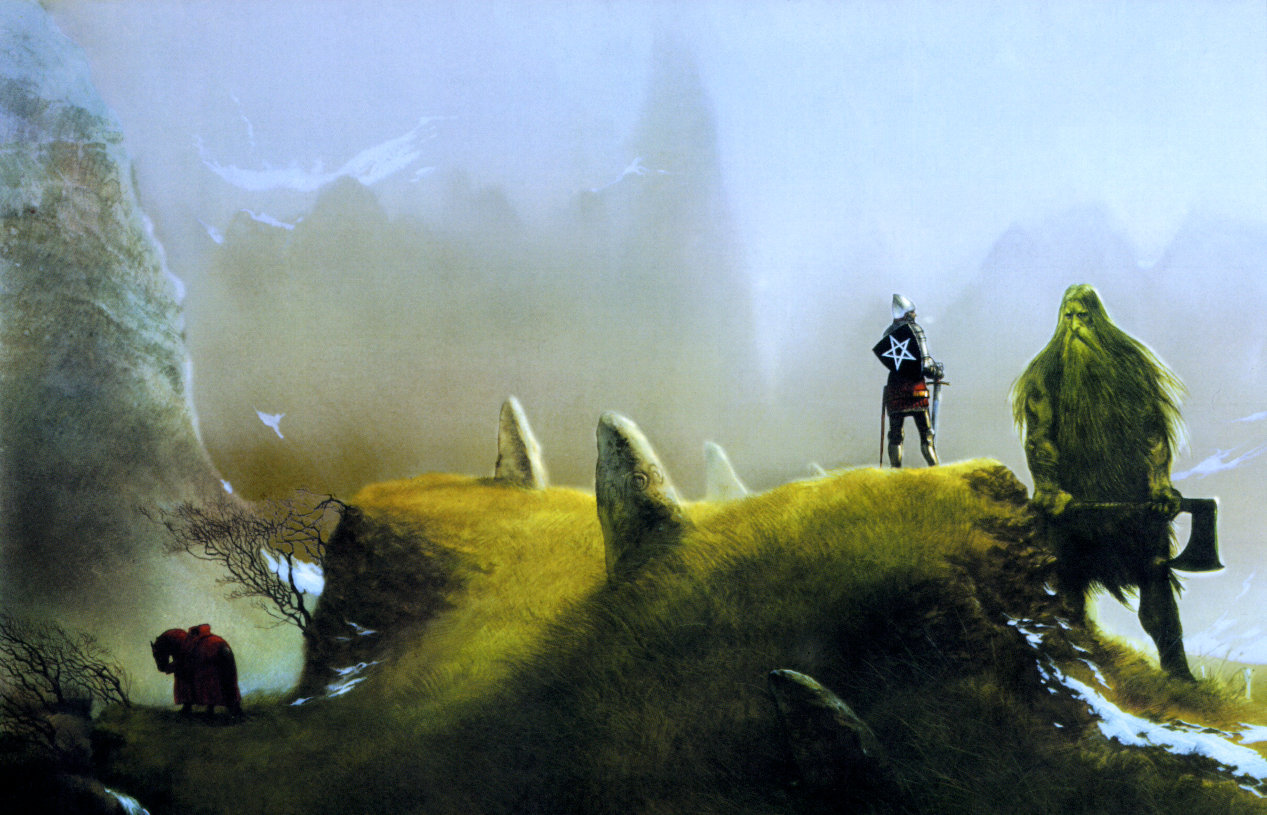
There, that’s me going on and on. I’m sorry there
is no audio visual to go with this. I can only present this awesome illustration
of sir Gawain and the Green Knight that Meg and I couldn’t work into our
presentation.
And God save al this faire compaignye!
Subscribe to:
Posts (Atom)