Showing posts with label Andrew. Show all posts

Tuesday, December 17, 2013

The End


It’s sad to say goodbye to such a great class. It has been a lot of fun. On the subject of endings, I am fascinated by Chaucer’s ending of the Canterbury Tales. The whole time I was thinking it would end much as it began, in the framing narrative with a declaration of the winner and some parting comments. Instead we get and ending that seems to flow directly from the Parson’s “tale,” focusing on Chaucer’s works and revoking a good number of them:

Wherefore I beseke yow mekely, for the mercy of God, that ye preye for me, that Crist have mercy on me and foryeve me my giltes; and namely of my translacions and enditinges of worldly vanitees, te whiche I revoke in my retracciouns: as is The Book of Troilus, The Book also of Fame, The Book of the xxv Ladies, The Book of the Duchesse, The Book of Seint Valentines day of the Parlement of Briddes, The Tales of Caunterbury, thlike that sownen into sinne…(1083-1085).

It is quite surprising to see him equivocate his “giltes” with a list of his work, or at least make them something he needs forgiveness for. It sounds very much like a confession to the reader, the person who understands the stories and what he could be forgiven for. While there were parts of the tales that I thought he might appropriately apologize for (Melibee perhaps), I was surprised to see the CTs in that list. I have heard of some of the other works in there but haven’t read them, so can’t say what is in them. All the same, these are works that people are still reading some six hundred years later and this list makes me wonder if we he would want us to. It’s a strange feeling. I read the notes for this section and they explain that there are many theories about why this is here, from deathbed recantations to mistaken inclusions to literary convention. They way this is written makes me want to say that this ending is the one that is meant to be here, perhaps because it comes so strongly on the heels of “The Parson’s Tale.” It is almost like Chaucer was moved by what he was writing while he was writing it, and by the end did not have the heart to return to the framing narrative.  It makes the whole question of who had the best story moot. Not the ending I was expecting at all.

Thursday, December 5, 2013

Leave Order Out of the Pot


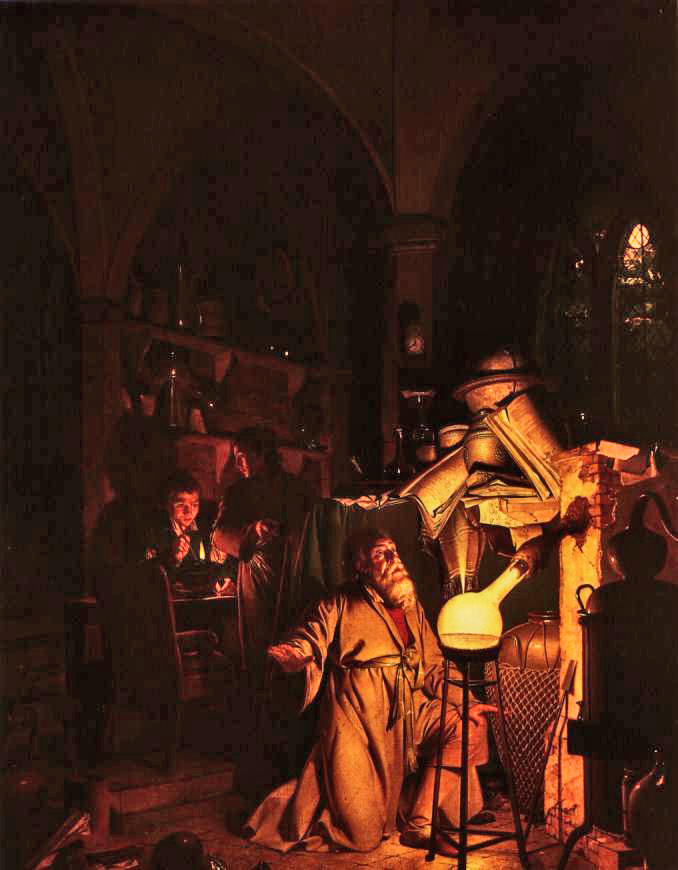
The canon’s yeoman is not the first scientist/magician we have met throughout the Canterbury Tales and yet the treatment of alchemy seems unique among collection of physicians, magicians, and illusionists. Probably one of the best (and most concise) descriptions of the foolery that is alchemy comes in the “Canon’s Yeoman’s Tale,” starting around line 906 and ending at 931. This is the moment the yeomen describes the catastrophe that occurred when their clay pot broke. He describes the explosion of the contents as such:
   Alchemist Pic Link
They percen so, and thurgh the wal they goon,
and somme of hem sinken into the ground—
Thus han we lost betimes many a pound—
And somme ar scattered al the floor aboute,
Somme lepe into the roof. Withouten doute, (911-915)

To add to the chaos of molten who-knows-what scattered about the room we then get alchemists scattered about the room blaming each other for the mishap. From their conversation it seems like they actually have no idea what happened. It was a fault of the fire, no the fire tender; actually it was the wrong kind of wood. Finally the master alchemist chimes in, “I am right skier that the pot was crased. / Be as be may, be ye nothing amased” (934-935), in other words, “cheer up. If the pot broke it was obviously already damaged; let’s try again our mix of explosive, molten stuff!” The overwhelming, overarching point of the Yeoman and his tale aside, this scene is beyond ridiculous even without knowing how ridiculous alchemy is from a scientific standpoint. Considering this outlook on alchemy, which is almost inseparable from other aspects of medieval science, I thought it interesting that the other appearances of similar things in the CT are put in a sober light. The wife of the knight in the WOB’s tale has both a sharp reason and the ability to shape shift. The physician gets probably the saddest and most sobering tale in the whole collection. Every wondrous gift in “The Squire’s Tale” seems cool beyond belief but also based on (what were then) reasonable ideas. And while the illusionist in “The Franklin’s Tale” may charge a lot of money, he delivers on his promised spells and they work fantastically.

            In trying to understand this difference, I looked back at the illusionist in “The Franklin’s Tale.” His process for creating his spells is completely different from the alchemists’. Where all of their emphasis is on the varying combinations of ingredients they add, the illusionist spends all of his time waiting, “That night and day he spedde him that he kan / To waite a time of his conclusioun” (“The Franklin’s Tale” 1262-1263). Further, he finally creates his spell when “at laste he hath his time yfounde” (1270). It seems then is that for the illusionist timing is literally everything. He knows enough about how the heavens move and how that affects the earth that he need only attempt is spell in its proper place for it to work. It might be a stretch, but this seems to tie into the theme of knowing your place and doing it well that is exemplified by several other tales in this text. Perhaps the reason that alchemy is not treated seriously is because almost by its nature it is trying to disrupt the order of things instead of using them, making gold of lead. That may not be a 100% true all the time but it seems to be part of what Chaucer is doing with alchemy.

Saturday, November 16, 2013

Mutually Assured Destruction


            So in class Dr. MB set out the idea that the combination of Thopas and Melibee is to point out how stories turn out when they are either all form or all content. I thought it was an interesting idea and it seems to make sense. However, thinking back over the tales I am starting to see some points that don’t appear to fit. For example, for being a tale that stresses form way too far, “Sir Thopas” is a pretty ramshackle construction. The rhyme changes without reason. The stanzas go on for so long with six lines and then at seemingly random places jump to seven then back down again. Plus, as Dr. MB pointed out, the length of fits is based on an untenable pattern.  So if “Sir Thopas” is supposed to be the tale with all shell and no insides why is the shell so deformed?
 Pondering over this I looked back over the “Tale of Melibee.” When Melibee is first gathering advice from the mob of people he invited over, he got some interesting advice from the surgeons. They said “that right as maladies ben cured by hir contraries, right so shal men warisshe were by vengeaunce” (1017). When I read that I thought they were saying that the cure for war was vengeance because vengeance is war’s opposite. I didn’t understand why they were opposites but I let it be and moved on. Later on we learn that Melibee was also confused by their statement. He said “right as they han doon me a contrarye, right so should I doon he another… and thane I have cured oon contrararye by another” (1280-1282). After this, Prudence tells him he is wrong, quotes Paul, and proves that what they really meant was that “for good and wikkednesse ben two contraries, and pees and werre…” (1289). She goes on that you have to heal things with their opposite; so to heal war you use peace. Having recently heard a good presentation on medieval medicine (again, good job with that), I can see that what she is saying and that she is probably right. Still, I would have never have got so much from what the surgeons actually said.
            Ok, I am going to answer questions before they are asked. Yes that is all outside what we were supposed to read. Let me say that I was feeling adventurous, which may have actually been a touch of stupidity, when I sat down to read this tale and I went ahead and read the whole thing. I can say now that it doesn’t get any better in the middle. Back to the tale…
            Maybe I am being nitpicky, but it seems that some of the arguments prudence makes are of the kind I would be proud to pull off in a close reading paper. Some of the things she works with (what the surgeons said is my best example) don’t seem as clear and sturdy as she makes them out to be. It seems that the logic of this story is not only tedious but shaky in places. I think that the “Tale of Melibee” has the same sort of problems with its content that “Sir Thopas” has with its form. Perhaps what Chaucer is getting at is that when your take once piece of storytelling and not the other not only do you get bad tales, but also the very element that you isolate breaks down. Form starts to break down when it has nothing on the inside, and content becomes illogical with nothing to put it in shape.

Tuesday, November 5, 2013

Knocking on Death’s Door With a Stick


I am fascinated by the old man. On first read he seemed like a personified death (which did not seem to be too great a stretch considering death has already been personified by the tavern keeper and the three friends) come to toy with these three fools. Yet, on a second read I am not so sure. Apparently this man is extremely old and looks it. One of the riotoures asks him why he is so old, either the asker is super short sighted and dumb (well… I suppose he is) or the man looks like he has been walking from Flanders to India and back for a couple hundred years (I made that number up). It is probably a mixture of both. From his following speech, it seems like this man has trouble dyeing, though I have to say is situation is a little confusing. I am having a hard time telling how much is literal and how much is poking fun and the fool’s impertinent question.
The line that is throwing me off is 727, “Ne deeth, allas, ne wol nat han my lif!” I am pretty sure I know each individual word, but when combine with the triple negative and separated subject it gets tricky. Right now I am operating under the reading that he is saying death will not have his life, which is why he spends his time knocking on the ground saying “Leeve modor, leet me in!” (731). He wants to die but cannot for whatever reason. If this is the case then it presents an interesting moral for the story. The presence of this old is not so much about drinking and gluttony (as much as the pardoner pushes that), it seems like he is really there to show the value of a timely death. It is foolish to try and “sleen this false traitour Deeth” (699); for one thing it is impossible and second because it is a bad idea to begin with.

Friday, October 11, 2013

Where that Wrascally Walter Went Wrong


I know we all hate Walter, and I think rightly so. But I wonder if we are supposed to learn from him as we learn from Grisilde. At the end of the tale we are told by the Clerk that “This storye is seid, nat for that wives shoulde / Folwen Grisilde as in humilitee, / for it were inportable…” (1142-44). It was said in class that we are not supposed to take Grisilde too literally. And here the Clerk lets us know that we are not supposed to actually use her as a model of behavior. Instead he indicates what we are supposed to take from this is, “But for every wight, in his degree, / Shoulde be constant in adversity” (1145-46). She is an exaggeration of that particular virtue. We are supposed to take away that idea not the specifics of her use of it. Walter may fall under a similar category. He seems to get points from the clerk (and ultamatly the people) for choosing a wife based on virtue not station. The clerk says “Thus Walter, lowely —nay, but royally— / Wedded with fourtunat honestetee” (421-422). The Clerk only starts ridiculing him when he decides to test her.

                        He hadde assayed hier inow bifore,

                        And fond hier evere good; what neded it

                        Hir for to tempte moore and moore

                        Thogh som men preise it for a subtle wit?

                        But as for me, I seye that ivele it sit (456-460).

According to the gloss, “assaye” is to make trial of. He has not really put her through any trial yet. He has only observed her in her daily life. The Clerk seems alright with that; it is further testing that he questions, “What neded it” and then later condemns “I seye that ivele it sit.” He says it is not only pointless and unnecessary, it is simply evil. It would seem that this is a moment similar to when he points out that real women should not follow Grisilde. Apparently some men have seen a “subtle wit” in what Walter does, but the Clerk is letting us know that this is just as excessive (perhaps more so) as what Grisilde does. Maybe what men are supposed to take away from Walter is that while choosing a wife based on virtue not status is a good thing, it is not right for them to put that virtue to the test. It is immoral and, if you have gone into it with both eyes open, totally pointless.

Sunday, October 6, 2013

Quiten him every grot?


As odd as it seems, I actually thought that the Summoner’s Tale was not nearly as scathing as I expected, especially after reading the prologue. The tale just did not quite live up to the remark that Satan should “Shewe forth thin ers, and lat the frere se / Where is the nest of frères in this place” (1690-1691). I think part of it was the contrast between it and the Friar’s Tale. In class we talked about the moment right before the summoner is taken by the fiend. He had a chance to repent and completely denied it, saying that “that is nat min entente…/…for to repent me” (1630-1631). It seems there is a very specific place where the summoner severely fails. I don’t see as much of that with the friar. Sure there is the moment that he gets his reward for greed, but his offence does not seem to come to a point like the summoner’s.

The closest to it is the moment the sick man tells him about to take something he has hidden (the location of which raises no question in the friar’s mind. odd). When the hears it, “‘A!’ thought this frere, ‘that shal go with me!’” (2144). Even after he got the sick man’s “contribution” then the friar sees nothing wrong in his own conduct. He complains to the sick man, and he complains to lord of the land. We do not even get his reaction to the squire’s unique solution. It seems the summoner is trying to point out the persistent state of friars. Maybe the point is that friar’s never see their wrong and are stupid, destructive, and greedy. Even so, it does not seem like the summoner has “quiten him every grot” (1292) when summoner’s are destined to hell but friars only have to put their nose to the wheel.

Monday, September 30, 2013

The Other Half


Here is a strange hypothesis. Reading through the Wife of Bath’s Prologue again gave me an idea; I’m not sure it’s a good one but here it is. One of the questions we discussed in class was whether the Wife of Bath was supposed to be sympathetic or not. Perhaps the question beneath that is: is the Wife (I’m going to call her that through the rest of this. It’s easier) presented as herald of positive change in women’s role or is she the model for women of what not to do and for men who not to marry? I’ll argue it’s neither. What if her presence on the pilgrimage and her extraordinarily long prologue are not comments on women’s behavior at all, but rather on men’s? Let me explain a little.

            The prologue opens in the middle of an apologetic discussion. The Wife is making a case for her situation and beliefs, pulling from the Bible and classical literature, yet it seems that these bits are given a rather lose interpretation or are half quoted.  Not being an expert on Ptolemy, I’ll stick to the arguments she relies on the Bible for. I could probably go on and on about almost every reference she makes to the Bible but I want to focus on a particular passage that caught my eye. Speaking of her husband (I don’t know which one particularly), the Wife pulls out a pair of ideas one from Corinthians and the other from Ephesians:

I have the power during al my lif

Upon his proper body, and nat he.

Right thus th’ Apostle tolde it unto me,

And bad oure housbonds for to love us wel;

Al this sentice me liketh everydel.’ (159-162).

It is interesting that she ends the statement with “Al this sentice me liketh everydel.” She is implying that she has considered the whole statement and likes every bit of it. According to her she this is a solid basis for her argument. That however is literally half the story. I think it is safe to assume that many if not most of her audience would be familiar with the passages she is referring to. I can’t read Latin and nor do I have the Bible in middle English (which of course she probably didn’t have either) but here are the passages from the New King James Version which I think is close enough for my purposes:

1 Corinthians 7:4 “The wife does not have authority over her body, but the husband does. And likewise the husband does not have authority over his own body, but the wife does.”

Ephesians 5:22,25 “Wives, submit to your own husbands, as to the Lord…. Husbands, love your wives, just as Christ also loved the church and game himself for her.”

The Wife of Bath has pulled exactly half of these passages for her argument, which is what she wanted and nothing more. Her argument is based on what she wants her argument to be. From there she can find support for it because she wants it to be there. I could go on about this but I wondered: how often was the other half, and just the other half, used in medieval society? I’m no expert but what I remember from class discussions and a little of my own digging was that the women was very nearly the property of her husband in medieval society. No doubt our society emphasis the negatives disproportionately with the reality but there is also no doubt (correct me if I’m wrong Dr. M-B) that Medieval English law favored the man more than the women in most regards.

            Sorry I’ve been going on for a while now, don’t worry I’m almost done. Right before we learn that the Wife’s arguments (at least in this instance) are based on only what she wanted she uses what I thought rather severe words to describe the position of her husband to her; “Which shal be bothe my dettour and my thral” (155). Once I got past the strength of these descriptions (he shall be her debtor and slave) I realized a similarity with something Custaunce said in The Man of Law’s Tale. She said, “Wommen are born to thralldom and penaunce” (Man of Law’s Tale 286). The similarity is striking. Both contain “thrall” or “thralldom” and both contain ideas of debt or “penaunce,” which is paying for some wrong doing or debt.  It seems then that the Wife seeks to place men where men place women. All this to say that it seems that the Wife of Bath has been painted like this to point out the extreme lopsidedness that men assume with the same flawed logic. I think that as she repulses her audience they cannot but realize she has exactly the same basis for what she does as they do. The only difference is that she uses the other half of the whole.

            I apologize for making this so long. A applaud your patience for making it this far. Now you know why I only brought up part of it in class.

Thursday, September 12, 2013

Lions, Tigers, and Prayers.


Lions, Tigers, and Prayers.

            I was thinking back on the Knight’s Tale and something Meg pointed out to me. It was that as Palamon and Arcite fight in the forest glade they are compared to animals. I could make statements about representing ferocity or the fact that animals were used all the time in heraldry (well actually I do want to talk about heraldry but not yet) that pertain to that passage, but what I realized that the two knight keep those descriptions. Both in the forest and in the arena Palamon is a “wood leon” (1656 and 2629-2632) and Arcite is always “cruel tigre” (1657 and 2626-2629). Actually here are the two passages.

            Thou mightiest wene that this Palamoun

            In his fighting were a wood leon,

            And as a cruel tigre was Arcite. (1655-1657)


And then the arena.

            Ther nas no tigre in the vale of Galgopheye,

            Whan that hir whelp is stole whan is lite,

            So crule on the hunte as is Arcite,

            For jalous herte, upon this Palamoun;

            N’in Belmarye ther nis so fel leon,

            That hunted is, or for his hunger wood,

            Ne of his praye desireth so the blood

            As Palamon to sleen his foo Arcite. (2626-2633).

Now certainly the last description is more elaborate than the first, but it is the same comparison. I think I am willing to attribute to Chaucer enough skill that he could have come up with something else if he really wanted to. Or if we want to stick with the idea that this story is in character of the knight, I’ll give him the benefit of the doubt and thousands of lines of poetry and say that he could have thought of something else too. So, it seems that this is deliberate consistency and might say something about the character of both.

            Palamon is the mad, it would seem both angry and crazy (wood and desireth so the blood) lion. In heraldry the lion is a beast of nobility and kings. Then to make it crazy creates a blunt, straightforward, but unstoppable force. This seems to be exactly who Palamon is. We know he was quite angry about Arcite’s confession of love in the tower. We also know he is as brutally honest as a cudgel because he turned himself and Arcite in as soon as Theseus asked. This would explain his application to Venus. Love is what he wants so love is what he asks.

            Arcite is the tiger. I don’t know a whole lot about the tiger in heraldry but in this description he is a “cruel tigre.” And not only cruel but cruel “For jalous herte” (2629). The term cruel in combination with “hunt” seems to imply some amount of cunning. This is also a perfect description of character. As he dies Arcite confesses that he fought with his cousin for “jalousye” (2784-2785). He also seems to exhibit a certain amount of conniving. He sneaks into Theseus household, argues his way out of bonds of brotherhood, and I think prays to mars because of it. He thinks that an application to love will be vain because it’s the victor who weds Emelye. So, in an effort to cheat the system he pleads to the god of war.

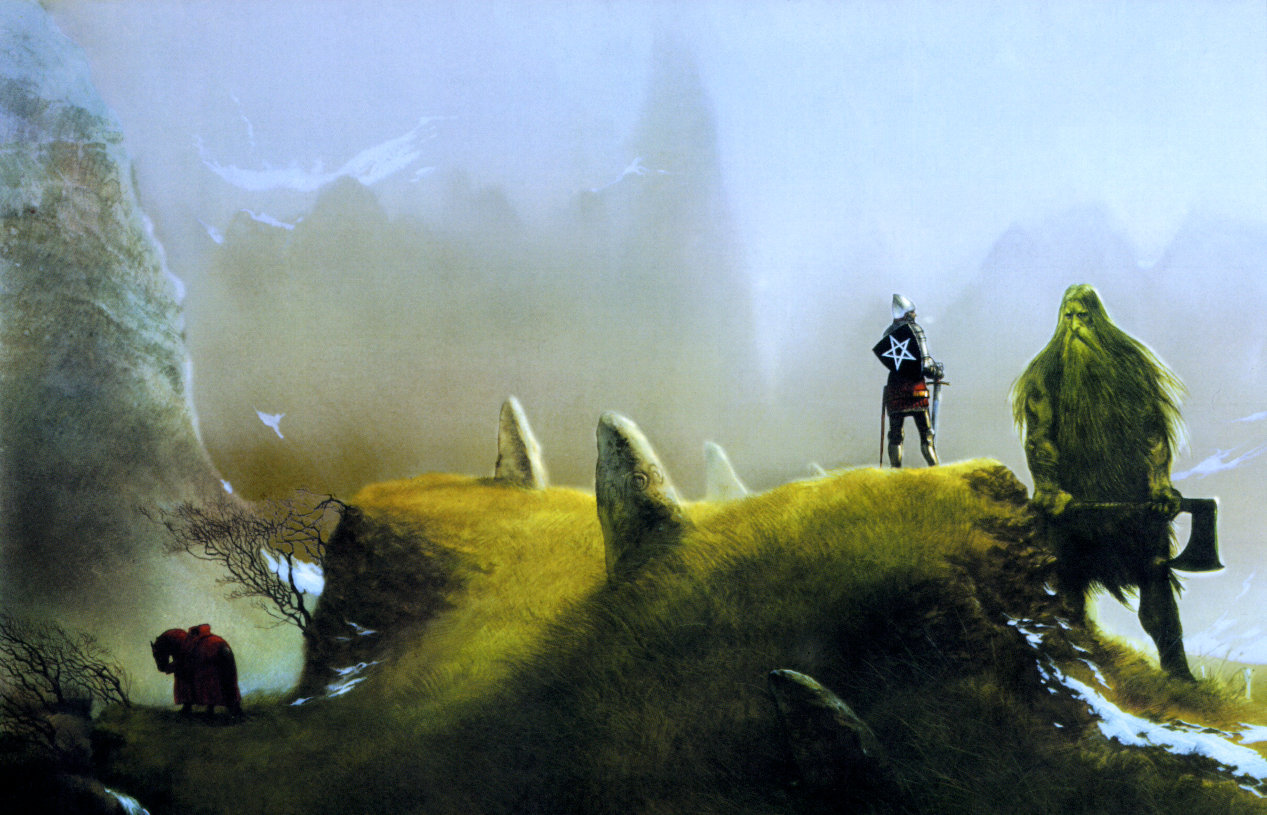
There, that’s me going on and on. I’m sorry there is no audio visual to go with this. I can only present this awesome illustration of sir Gawain and the Green Knight that Meg and I couldn’t work into our presentation.


And God save al this faire compaignye!
Sir Gawain and the Green Knight by John Howe.
From the poem:
The green knight got ready, feet firm on the ground;leaned his head a little to let the cheek show,and raised the rich riot of his hairso the nape of his neck was naked and exposed.Gawain held the ax high overhead,his left foot set before him on the floor,swung swiftly at the soft fleshso the bit of the blade broke through the bones,crashed through the clear fat and cut it in two,and the brightly burnished edge bit into the earth.The handsome head fell, hit the ground,and rolled forward; they fended it off with their feet.The red blood burst bright from the green body,yet the fellow neither faltered nor fellbut stepped strongly out on sturdy thighs,reached roughly right through their legs,grabbed his graceful head and lifted it from the ground,ran to his horse, caught hold of the reins,stepped in the stirrup, strode into the saddle,the head dangling by the hair from his hand,and seated himself as firmly in the saddleas if he were unhurt, though he sat on his horse withouta head.                He swiveled his bulk about;                the ugly stump still bled.                They gaped in fear and doubt                because of the words he said.